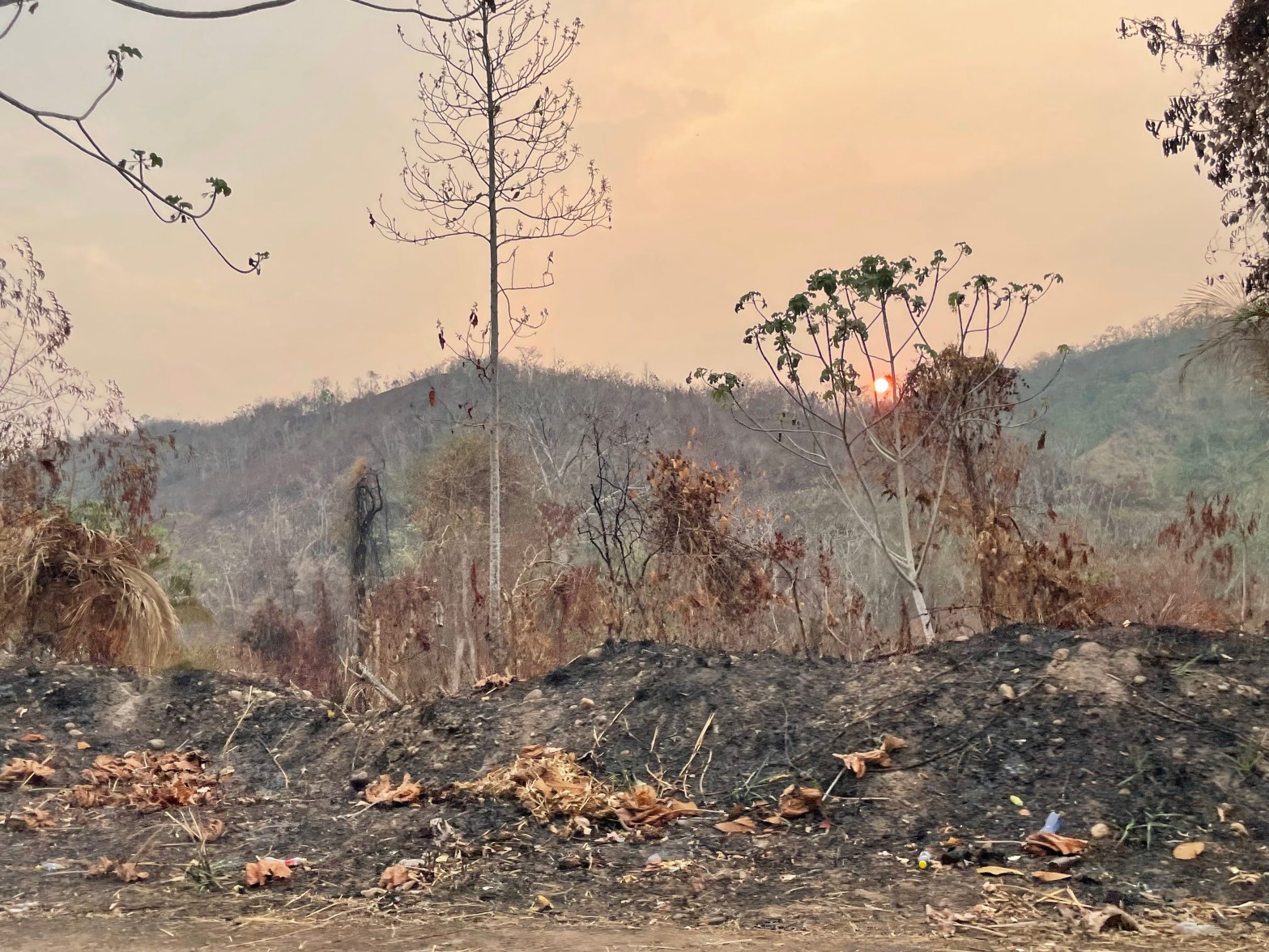
Today the Amazon is facing its most critical moment the as the “tipping point” has now tipped. Tierra Selva has been on the frontlines in San Martin, monitoring and documenting the growing number of uncontrolled wildfires and their ensuing impacts. As of September 11, 2024, 1,370.71 hectares of crops have been lost in the region, and another 1,100.86 hectares. This is excluding other departments such as Amazonas which have also been under severe threat. With a two-month drought period coupled with traditional agricultural slash and burn practices. As of Sunday September 15th the region has been battling some 10 giant blazes in the 10 provinces of San Martin, not including those that have been ongoing since June 2024.
Hoy la Amazonía enfrenta su momento más crítico ya que el “punto de inflexión” ha sido superado. Tierra Selva ha estado en primera línea en San Martín, monitoreando y documentando el creciente número de incendios forestales no controlados y sus consecuentes impactos. Hasta el 11 de septiembre de 2024, se han perdido 1,370.71 hectáreas de cultivos en la región, y otras 1,100.86 hectáreas. Esto sin incluir otros departamentos como Amazonas que también han estado bajo una grave amenaza. Con un período de sequía de dos meses junto con las prácticas agrícolas tradicionales de tala y quema. Hasta el domingo 15 de septiembre la región ha estado combatiendo unos 10 grandes incendios en las 10 provincias de San Martín.
Currently, some 1,997.96 hectares of pristine rainforest has been lost to date and some 1,536.76 hectareshave been impacted in our region alone. This is the equivalent of more than 7,750 soccer fields that have been directly and indirectly impacted by these fires. Furthermore, some 533 hectares of cacao and coffee crops have been destroyed impacting local farmers and livelihoods. The devastation is beyond words as Peru’s biodiversity and ecosystems, flora and fauna are severely impacted. Temperatures have continued to rise to levels never seen before with some 43C degrees registered in places along the central Huallaga stretch. Air quality has diminished at levels never seen before such as the Index of Air Quality (Indices de Calidad del Aire (ICA) has reached a high of 51 and is expected to reach 66 during the next several days.
Actualmente, se han perdido aproximadamente 1,997.96 hectáreas de selva tropical virgen y 1,536.76 hectáreas han sido afectadas solo en nuestra región. Esto equivale a más de 7,750 campos de fútbol que han sido directa e indirectamente impactados por estos incendios. Además, se han destruido 533 hectáreas de cultivos de cacao y café, afectando a los agricultores locales y sus medios de vida. La devastación es indescriptible, ya que la biodiversidad y los ecosistemas de Perú, su flora y fauna, están gravemente afectados. Las temperaturas han seguido aumentando a niveles nunca antes vistos, con algunos lugares a lo largo del tramo central del Huallaga registrando 43°C. La calidad del aire ha disminuido a niveles nunca antes vistos, como el Índice de Calidad del Aire (ICA) que ha alcanzado un máximo de 51 y se espera que llegue a 66 durante los próximos días.
The region is in a critical state of emergency, yet the lack of an adequate response from the central government has worsened the crisis, and the local community is on constant alert. Water scarcity due to the dry conditions have further exacerbated the control of wildfires as the mighty Huallaga has reached its lowest point in a decade, with tributary rivers also running dry. The region is also suffering from poor water management and conservation efforts impacting community and fire-fighting conditions, as water restrictions are in effect. This has made firefighting efforts even more challenging.
La región está en un estado crítico de emergencia, pero la falta de una respuesta adecuada por parte del gobierno central ha empeorado la crisis, y la comunidad local está en alerta constante. La escasez de agua debido a las condiciones secas ha exacerbado aún más el control de los incendios forestales, ya que el poderoso Huallaga ha alcanzado su nivel más bajo en una década, con los ríos tributarios también secos. La región también sufre de una mala gestión y conservación del agua, lo que afecta las condiciones de la comunidad y la lucha contra incendios, ya que las restricciones de agua están en vigor. Esto ha hecho que los esfuerzos de extinción de incendios sean aún más desafiantes
Overall firefighting efforts have seen local communities fend for themselves with limited to no equipment provided, using personal buckets, backpack or handheld sprayers as well as shovels and even palm branches. Volunteer firefighters are also lacking adequate equipment. The regional government has been quoted by townspeople as being inadequately prepared by leaving the firefighting to community members, ronderos, and local municipalities to deal with the blazes.
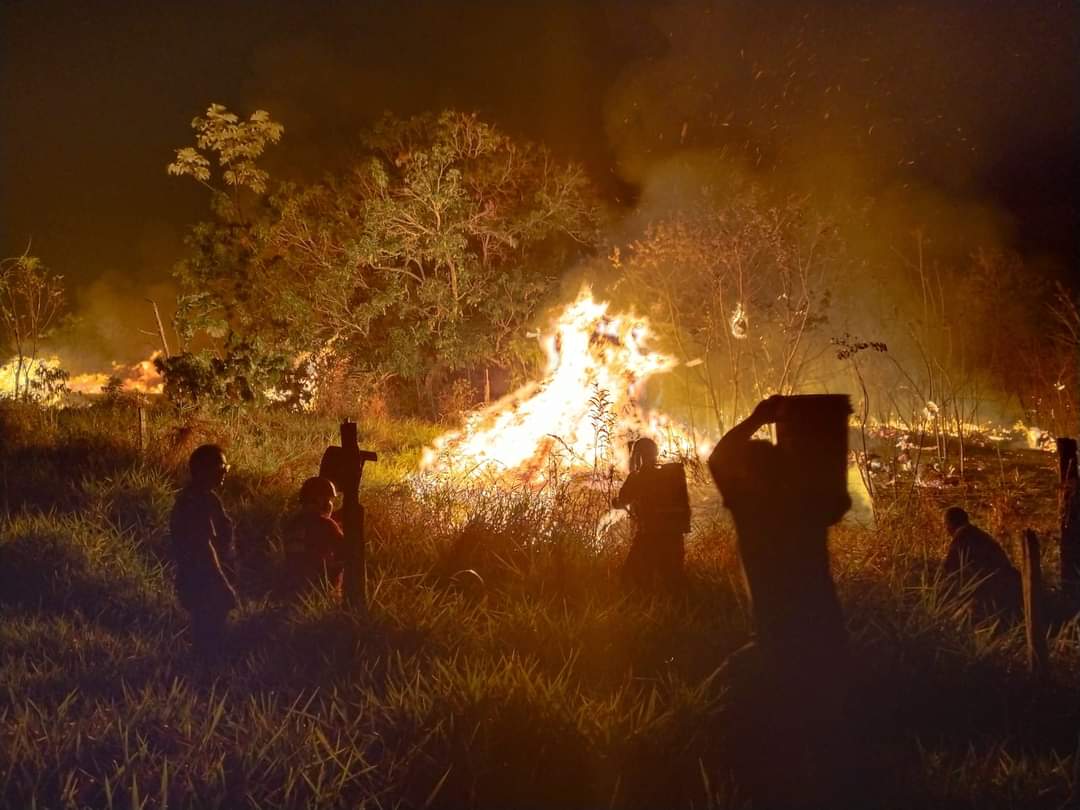
All are ill equipped to manage and contain these giant fires. It is clear that emergency preparedness needs to be addressed by all government, industry and communities and civil society organizations.
En general, los esfuerzos de extinción de incendios han visto a las comunidades locales valerse por sí mismas con poco o ningún equipo proporcionado, utilizando cubos personales, pulverizadores de mochila o de mano, así como palas e incluso ramas de palma. Los bomberos voluntarios también carecen de equipo adecuado. Los habitantes de los pueblos han citado al gobierno regional como inadecuadamente preparado, dejando la extinción de incendios a los miembros de la comunidad, ronderos y municipios locales para lidiar con los incendios. Todos están mal equipados para manejar y contener estos incendios gigantes. Está claro que la preparación para emergencias necesita ser abordada por todos los gobiernos, la industria, las comunidades y las organizaciones de la sociedad civil.
Tierra Selva will continue to provide updates on this crisis.
 tierraselva
Tierra Selva
Thank you for being Ears and Eyes in this heavy and serious situation.
Best regards
Turid
LikeLike